NGC 2371
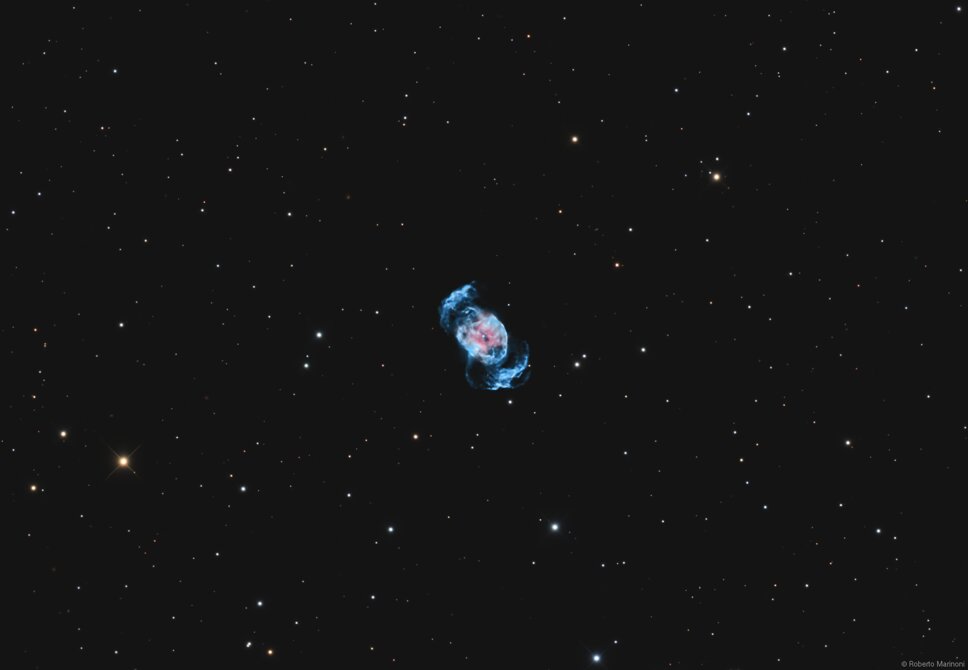
About image
NGC 2371 is a planetary nebula in the constellation Gemini, about 3,900 light-years from Earth.
It was discovered by William Herschel in 1785, but was only recognized as a true nebula in 1917.
It has a diameter of only 62 inches and appears as an irregular disk surrounded by gas that gradually fades towards its edges.
It displays a clear bipolar appearance: this morphology suggests that the two condensations of matter are part of a torus of gas.
I shot this nebula in two nights with moon very invasive, but the nebula is quite bright and has a good response with narrow band filters.
In the image Ha and OIII signals were used for the nebula itself, while RGB was used only for the stars. I pushed more with OIII in order to highlight better the external lobes and their faint connection with the central disk of the nebula.
Processing was not so easy as I thought. The OIII signal is so strong to overwhelm quite all the Ha signal: so, whe doing the HOO Pixelmath combination, I decided to enhance the Ha signal and to decrease a bit the OIII, in a way at least to show some Ha emission in the central part of the nebula.
Technical data
Optic GSO RC12 Truss - Aperture 304mm, focal lenght 2432mm, f/8
Mount 10Micron GM2000 HPSII
Camera ZWO ASI 2600MM Pro with external filter wheel for Ha/OIII
Filters Astrodon Gen2 E-Serie Tru-Balance 50mm unmounted RGB , Astrodon 50mm narrowband filters Ha 5nm and OIII 5nm
Guiding system OAG-L ZWO with guide camera ASI 174 Mini
Exposure details R 12x60" bin3 -15C gain 100
G 12x60" bin3 -15C gain 100
B 12x60" bin3 -15C gain 100
Ha 36x300" bin3 -15C gain 100
OIII 54x300" bin3 -15C gain 100
Total integration 8h6'
Acquisition Voyager, PHD2
Processing Pixinsight 1.8, Photoshop CS5, BlurXTerminator, NoiseXTerminator, StarXTerminator
SQM-L 19.28
Location Promiod (Aosta Valley, Italy), own remote observatory
Date 12/13/14 December 2025
© Roberto Marinoni 2019 - All rights reserved