M 97 Owl Nebula
About image
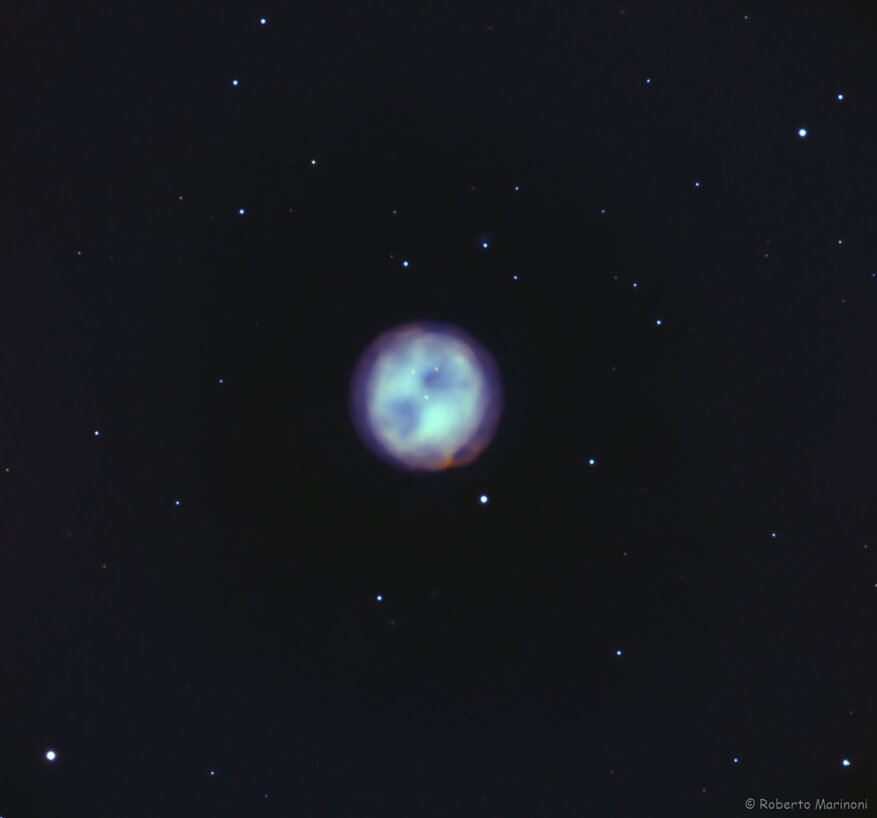
M97, also known as the Owl Nebula, is a planetary nebula visible in the constellation of the Ursa Major; it was discovered by Pierre Méchain in 1781.
The name "Owl Nebula" was instead assigned by William Parsons in 1848 because of the two dark spots, which resemble the eyes of an owl.
M97 is one of the most complex planetary nebulae. Its appearance has been interpreted as a sphere without poles, with the eyes of the owl in correspondence with the poor areas of matter at the poles. Its age is estimated at 6,000 years.
M97 is one of the largest known planetary nebulae, in absolute terms: it extends for a diameter of almost 3 light years and its apparent magnitude is 9.9; the central star instead is an extremely hot white dwarf, of fourteenth magnitude, whose surface temperature is around 85,000 kelvin.
Technical data
Optic Celestron C9.25 Edge HD f/10
Mount Losmandy G11 with Ovision worm and FS2
Camera Atik 4000 with Starlight Xpress filter wheel 5 positions
Filters Baader Ha 7nm and OIII 8.5nm, 50.8 unmounted
Guiding system OAG LB Astro Proxima and Lodestar
Exposure details Ha 18x900" bin1 -25C
OIII 17x900" bin1 -25C
Total integration 8.8h
Acquisition Maxim, PHD2
Processing Maxim, Photoshop CS5
SQM-L 18.35
Location Home terrace (Rescaldina, Italy)
Date 22/26 February 2015
© Roberto Marinoni 2019 - All rights reserved